Amanda Respress, who lives in Jones County, said she drives 30 minutes to the nearest Publix to take advantage of their weekly deals. She also said she had concerns about the way Walmart treats its workers, but she has also started shopping there due to the heightened cost of groceries. She feels it’s a necessary sacrifice. Respress, who used to live in downtown Macon says that in both areas she had to drive to access a grocery store.
Repress is concerned for people living in Macon who don’t have a car, as they would struggle to access a grocery store. She also has concerns for people who are faced with buying groceries from dollar stores, which typically sell many food items at a higher cost per unit.
“So even though there may be a good selection of canned goods or sort of like non-perishables, that is not high quality nutritional food,” Respress said. “It’s not quality food and people who have more money and more access have access to better quality food.”
For families living in a food desert, dollar stores might be their only option. According to the USDA, low access or “food desert” census tracts are those with a high number of residents that are more than one mile away from the supermarket, or similar retailer. Census tracts are small subdivisions of counties that usually contain between 1,000 to 8,000 residents.
Connor Mullaly, Associate Professor of Food and Resource Economics Department at the University of Florida, published an article in the American Journal of Agricultural Economics focusing on the effects of dollar stores on food access.
“If we wanted a more intuitive definition, I think food desert usually just refers to neighborhoods that have poor access to grocery stores,” Mullaly said.
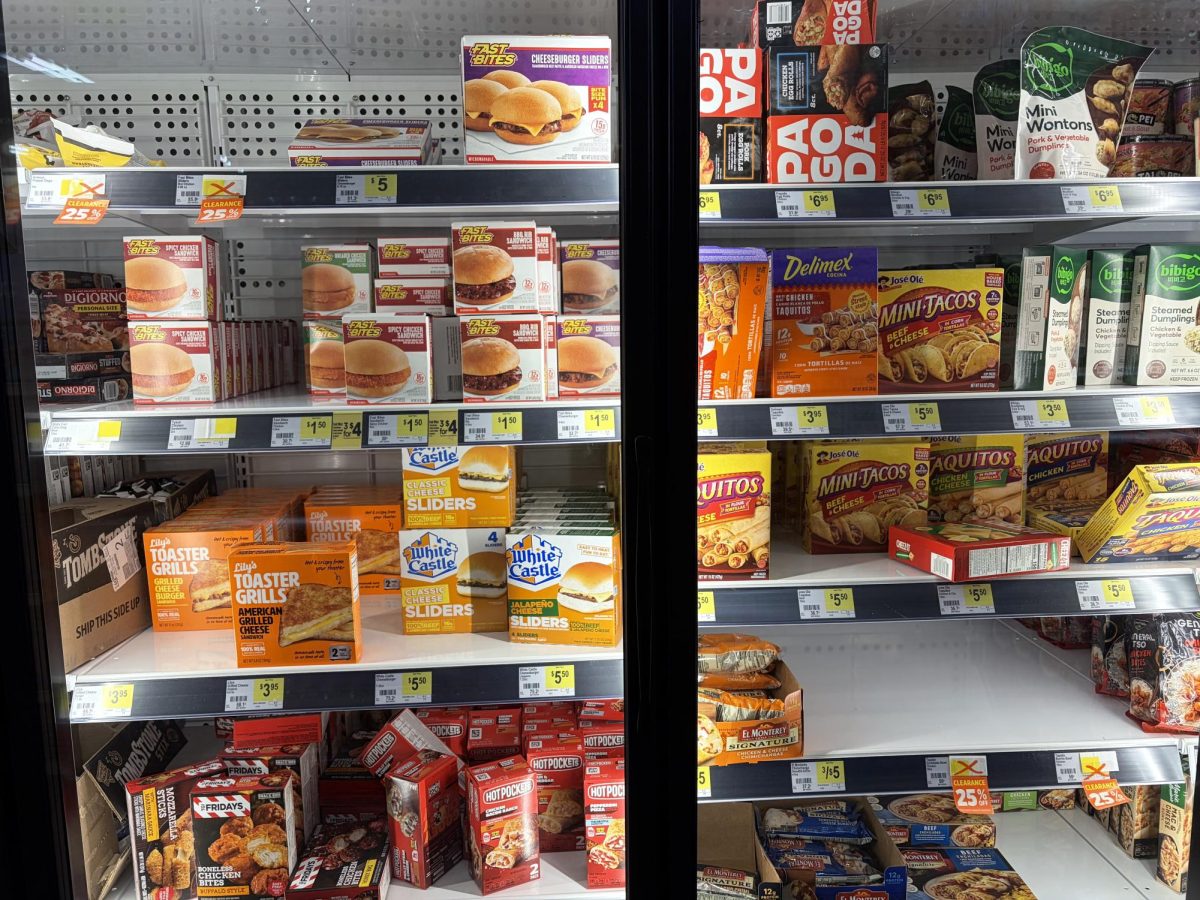
Despite a limited number of larger grocery stores that can be accessed without a car, in Macon there are around 40 different dollar or low cost stores. These stores, such as Dollar General or Family Dollar, typically sell shelf-stable items like canned goods and frozen foods. They rarely sell fresh produce, and while some locations might also sell milk and eggs, they are often sold at a higher mark up than traditional grocery stores.
For example a gallon of milk from a Dollar General in Macon on Martin Luther King Jr Boulevard costs $3.75, and a gallon of milk from Kroger at Eisenhower Crossing costs $2.79. Similarly, a dozen eggs from Dollar general costs $2.15, and from Kroger a dozen eggs costs $1.79.
Dollar stores might be the only option for someone without access to reliable transportation.
The stores often show up in neighborhoods tied to the legacy of redlining, a 1930s federal housing policy from the Home Owner’s Loan Corporation that labeled many Black neighborhoods in red, meaning they were “hazardous” for investment and lending programs. Today, many of those same redlined areas are considered food deserts, where access to fresh, nutritious food is limited.
“Redlining is a really good indicator of areas that are going to have lower nutritional access,” said David A. Davis, an English professor at Mercer University who studies food deserts. “And if we look today at a map of those redlined areas from the 1930s and a map of zones of low nutritional access, we’ll say they’re almost exactly the same map.”
Davis said that while dollar stores might look like a solution to areas that lack grocery stores, they really sell low-cost products at higher profit margins than traditional grocery stores. In a food desert, it’s also more likely for a locally owned grocery store to lose businesses.
“As the smaller stores go out of business, that tends to mean that the grocery stores are pushed to the peripheral suburban areas of communities and outside of the community area,” Davis said.
Mullaly said that while research points to dollar stores not competing with chain grocery stores, it also shows dollar stores competing with small, independently owned grocery stores.
According to a report named “The Dollar Store Invasion”, by Stacy Mitchell, Susan Holmberg, and Kennedy Smith, “Once a dollar store enters a food desert, the area is then more likely to remain without access to a supermarket.”
Dollar stores succeed when they are the only nearby store for people, forcing them to shop at a store that won’t provide them the fresh produce and options that a traditional grocery store will provide, according to the “The Dollar Store Invasion.” Dollar stores are also more likely to show up in areas with marginalized communities. The Dollar General on Martin Luther King Jr. Boulevard, is one of the only stores in the downtown area to have a selection of dairy, freezer, and shelf items.
According to the report, “Dollar General and Dollar Tree single out communities that have been marginalized economically and politically. In urban areas, they blanket Black and Latino neighborhoods, opening multiple outlets near one another.”
This creates a dynamic in which marginalized communities residing in food deserts are often forced to rely on low cost items that are sold at a higher markup than traditional grocery stores. As dollar stores expand in food deserts, they underscore how limited access continues to shape what communities can eat.
“I don’t know that a private grocery store would do well financially, but if it could be a co-op in some way and support local farmers and that kind of thing to bring fresh fruit into the area, that would be a great option,” Respress said.