
Nearly a decade after its opening, The Battery Atlanta has become central to how the Atlanta Braves generate revenue. But fans remain divided on whether the billion-dollar development has truly improved the experience of attending a game.
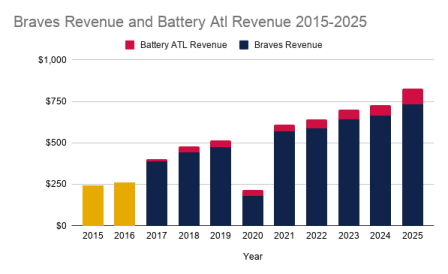
Since the Battery opened in 2017 alongside Truist Park, the Braves’ revenue has grown significantly. According to team financial data, revenue increased from $262 million in 2016 to $386 million in 2017, a 47% jump in a single year. By 2024, total revenue reached $663 million.
The Battery itself has become a steady income source, generating about $15 million in 2017 and growing to $67 million in 2024, accounting for roughly 10% of the team’s total revenue. Unlike traditional baseball income, which depends on the season, the Battery brings in money year-round through restaurants, retail, and entertainment.
For many fans, that expansion has reshaped what it means to attend a Braves game.
Abbey Cofer, a mechanical engineering graduate student and lifelong Braves fan, said her connection to the team has always been rooted in family tradition.
“My experience was very much through the passion group, specifically my grandfather,” Cofer said. “That was our bonding activity, going to the game and experiencing the atmosphere, the culture, more so than following stats game by game.”
But while the Battery has added new attractions, Cofer said it has also introduced new frustrations.
“It felt like a pay-to-win experience,” she said. “You gotta get lucky with your time. You gotta get close enough parking, and with the metro Atlanta traffic? Good luck with that. The Battery is a wonderful thing that seems sort of inaccessible for the average person.”
Crowding and accessibility were recurring concerns. Cofer described the area as “an overpopulated village,” where heavy traffic and long lines can make it difficult to fully enjoy what the development offers.
Still, other fans see the Battery as a major improvement, especially beyond game day.
Worth Smith, a GHSA umpire who previously lived in the Battery, said the development creates a year-round destination rather than a single-event experience.
“The experience doesn’t end with the game,” Smith said. “The experience begins before the game and it ends after the game. It expands the fan experience outside of just nine innings.”
Smith noted that even in the offseason, the area remains active. Fans gather to watch away games, visit restaurants, and spend time in the area even when the Braves are not playing.
“There’s a community that’s built because of people that live there,” he said. “It doesn’t really die down.”
That constant activity is part of what makes the Battery financially valuable. While traditional stadiums generate most of their revenue during games, the Battery allows the Braves to earn money throughout the year, making the organization less dependent on baseball alone.
Still, both fans emphasized that the development does not necessarily improve the sport itself.
“I don’t think the Battery itself is what’s really elevating the fan experience for baseball,” Smith said. “Baseball is baseball. Either you’re gonna love it because it’s baseball or you’re not.”
Instead, he said, the added attractions help broaden the audience by appealing to people who may not otherwise attend games.
“What it can do is bring people that maybe aren’t as interested in baseball to the game,” he said.
Cofer agreed, describing the Battery as a separate experience rather than an extension of the game.
“I honestly don’t really consider it part of the stadium,” she said. “I feel like it’s just a separate entertainment area altogether.”
That distinction raises questions about who benefits most from the investment. While the Braves organization has seen significant financial growth, fans had mixed views on whether those benefits extend equally to the broader public.
Cofer said the impact depends on how the development is used.
“As long as it’s not in a position where it can greatly imbalance something, I think that it’s very much up to choice,” she said.
Smith, however, pointed to the scale of activity and business generated by the Battery as evidence of its value.
“It’s constant,” he said. “People will constantly flow into that place, there’s not really a loss to be incurred in a major way because it’s just constantly making money.”
The project’s estimated $1 billion cost was not seen as unreasonable by either fan, particularly given the location and long-term revenue potential.
“I’m honestly surprised it was only one billion,” Cofer said, citing the complexity of construction and the value of building in a major metropolitan area like Atlanta.
Smith agreed, adding that continued expansion may delay profitability but could increase long-term returns.
“You’re not going to see a return on revenue until it kind of hits its max,” he said. “It’s not there yet, but it will certainly get there eventually.”
That ongoing expansion is part of the Braves’ broader strategy to capitalize on strong team performance and growing fan interest. With playoff appearances and major events like the World Series and All-Star Game, the organization has continued to invest in the Battery as both a financial and cultural hub.
However, the development has also raised concerns about affordability and accessibility. Housing in the area is considered high-end, with prices reflecting its location and amenities.
“You’re gonna pay a premium price, but you’re gonna get a premium experience,” Smith said, pointing to walkability, security, and proximity to entertainment as key selling points.
For Cofer, the issue comes down to balance. While the Battery offers opportunities for a more expansive fan experience, it also risks excluding those who cannot afford or navigate its costs.
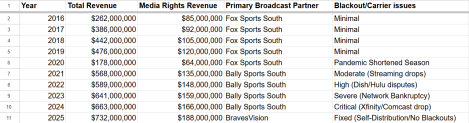
While The Battery has boosted the Braves’ physical presence, the at-home experience has grown more complex. Total revenue reached a record $732 million in 2025, yet fans faced increasing difficulty watching games at home due to broadcast blackouts.
In February 2026, the Braves terminated its media rights deal with Main Street Sports (formerly Bally Sports) to launch BravesVision, an in-house network. To bypass local blackouts, the team now sells a direct-to-consumer streaming service, Braves.TV, for $99.99 per season or $19.99 per month.
The shift to direct broadcasting is expected to create a surge in revenue for the Braves, adding to the growth caused by The Battery, while ensuring games are accessible to fans willing to pay a dedicated subscription fee.
Ultimately, the Battery represents a shift in how sports franchises operate, blurring the line between team and entertainment business.
For the Braves, the financial results are clear. Overall revenue has more than doubled since the development opened. For fans, however, the question remains more complicated, whether that success enhances the experience or simply changes who it is designed for.