Middle Georgia may not be the first basketball hotbed to come to mind, but the region has helped shape high school basketball in Georgia for decades. In March, Macon hosted the annual GHSA basketball state championships at the Macon Centreplex, continuing a tradition that has long made the city one of the state’s biggest stages for the sport, dating back all the way to 1969, when an unexpected underdog captured the first-ever Georgia state championship held there.
It was not a large school from the Atlanta Metro area, or a program with championship history. Rather, it was Crawford County High School, from a small town of less than 1,000 people: Roberta, Georgia. A town where one legendary coach helped turn basketball into the heartbeat of a community.
A Basketball Town
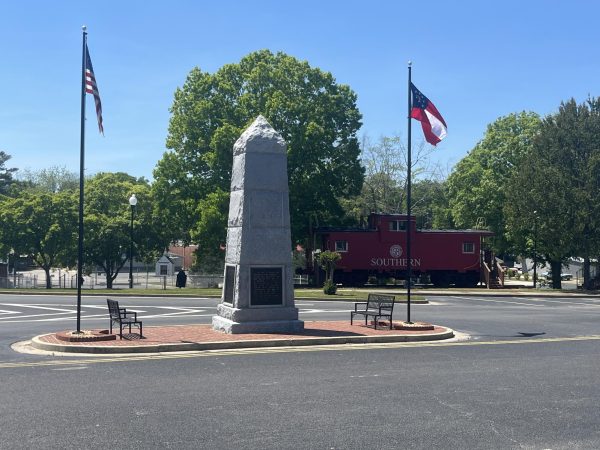
Drive through Roberta today, and it does not take long to see a hoop nailed above a garage or sitting at the end of a driveway.
Crawford County High School athletic director Craig Puckett put it simply: “Roberta’s definitely a basketball town,” calling basketball “the driving force” in the community.
The town’s love of basketball did not come out of nowhere. It was cultivated, in large part, by J.B. Hawkins.
Hawkins coached both the boys and girls teams at Crawford County from 1955 to 1980, leading the boys to an outstanding 649-293 record and the girls to an impressive 425-287 record. Over his 32 years as head coach, Hawkins became just the 4th Georgia High school basketball coach to ever reach 1000 wins, led his Crawford County Eagles to a state championship, made it to the state playoffs 19 times, and was eventually inducted into the Georgia Sports Hall of Fame in 2013.
For people in Crawford County, though, Hawkins was never just a name on a building or a face in the Hall of Fame.
Puckett, who grew up in Crawford County and now oversees its athletic programs, said Hawkins not only “made Crawford County a basketball powerhouse,” but became part of the town itself.
“Everybody knew where Coach Hawkins lived. If you needed him, you knew where to find him.”
Puckett explained that from the 1950s and all the way into the 1980s, “basketball was just about the only thing there was” in terms of extracurricular activities. Crawford County did not add football until the late 1970s, with baseball coming a few years later. In that setting, basketball became more than entertainment. It became part of the town’s identity.
Crawford County’s Defining Moment
That identity was largely shaped by the 1969 state tournament.
Coached by J.B. Hawkins and led on the court by Dr. Chuck Hawkins, J.B. ‘s son and the MVP of the state tournament run, the team was not favored to win the championship and was not even expected to win its first-round matchup.
The team wasn’t quite as big as their opponents. They didn’t have any high-level prospects, but they did have experience. Most of Crawford County’s players had grown up in Roberta, learning the fundamentals from Coach Hawkins. Most had played together from the time they were in grade school.
Puckett said Hawkins started with kids when they were young, stayed involved with them as they came up, and earned trust long before they reached varsity. By the time they got to high school, he said, “they were all bought in.”
In round one, Crawford County faced off against Saint Pius X of Savannah.
“They had come in runner-up the year before and were expected to win the whole thing,” Hawkins said. “We were expected to lose.”
However, coach Hawkins and his Eagles were able to pull off the upset, narrowly escaping with a 79-75 victory.
Following round-one, Crawford County dominated top-seeded Whigham in round two and Warren County in the semifinals, beating them both by 12 points, leading to a familiar foe in Pike County for the championship game.
“Pike County was in our region,” Hawkins said. “We played them in the region finals in their gym, and they beat us.”
That loss to Pike County was Crawford County’s only loss of the regular season, setting up perfectly for Crawford County to get its revenge.
The championship game was tight, but Crawford County pulled it out 66-61. Chuck Hawkins scored 37 points.
“I could have shot from half court, and it would have gone in,” he said. “It was crazy.”
For a school from such a small community, the championship was proof that Crawford County basketball could stand with anyone in Georgia.
Chuck Hawkins said the state title was easily the high point of his father’s time coaching.
“Without a doubt, that was a great moment in his career,” he said. “It was the apogee.”
It also cemented Hawkins’ reputation. Hawkins had reached the state championship game twice before in the early 1960s, falling short both times. After finally getting over the hump in 1969, Hawkins became more than just a local coach. He became one of the men who helped define what basketball looks like in Georgia.
Following the title run, Hawkins gained national recognition and was named runner-up for National High School Coach of the Year. He later turned down a higher-paying job at a larger Atlanta-area school, McEachren High School, choosing to remain in Roberta.
The Old Crawford County Gym
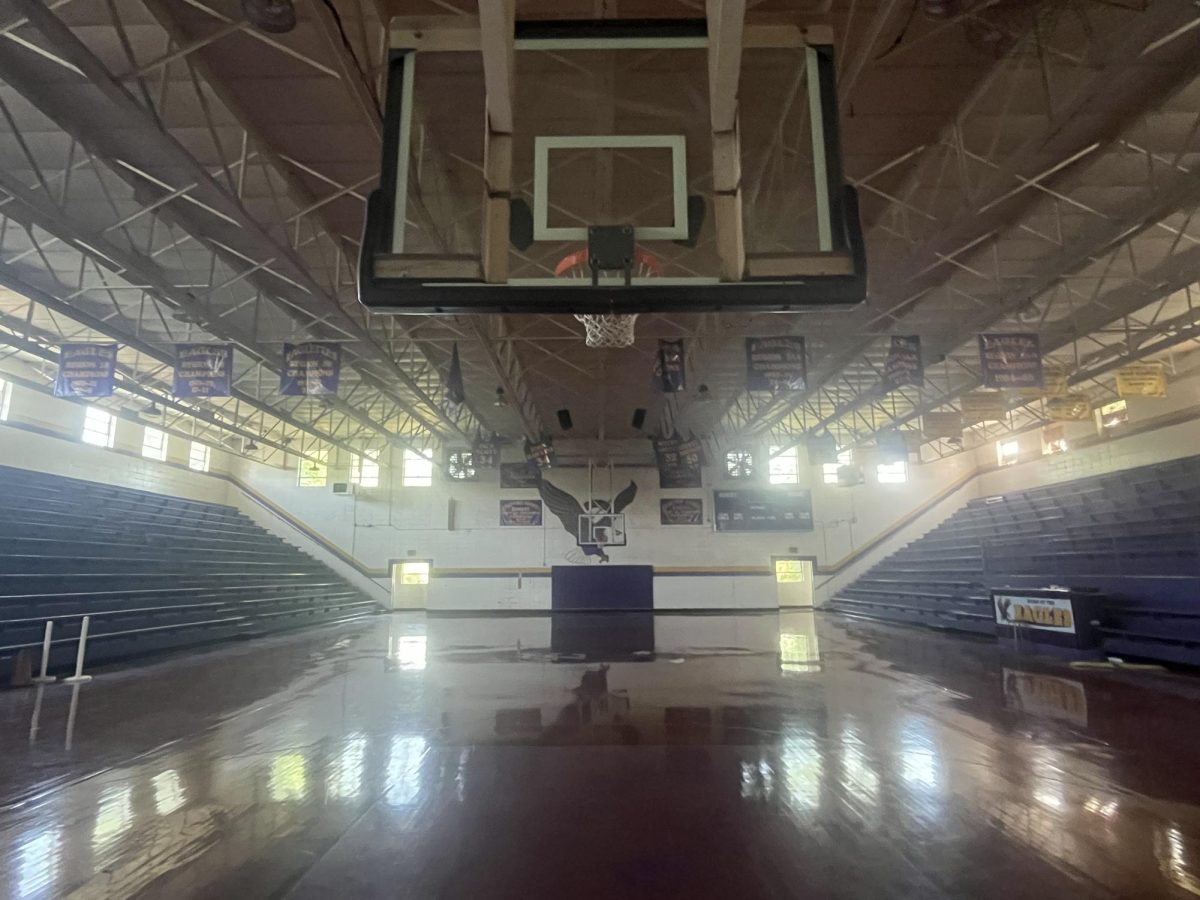
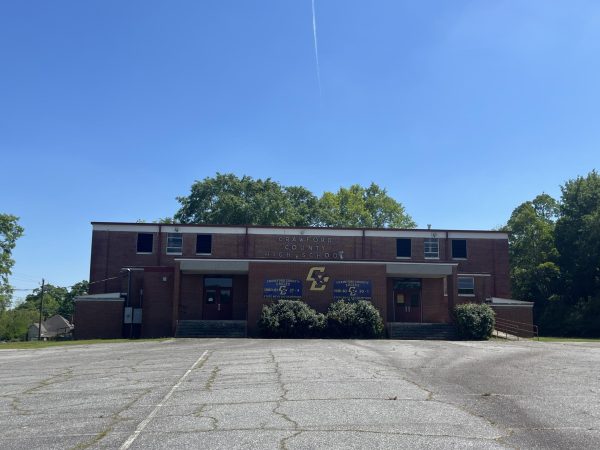
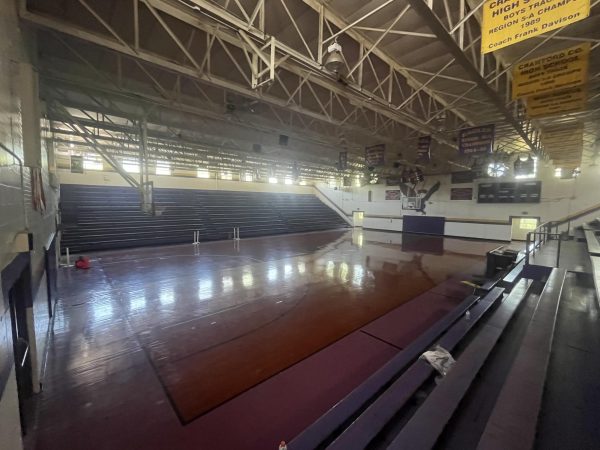
The legacy that the 1969 championship team left can still be seen in the old Crawford County High School gymnasium, which now sits abandoned in Roberta, replaced by newer facilities down the road.
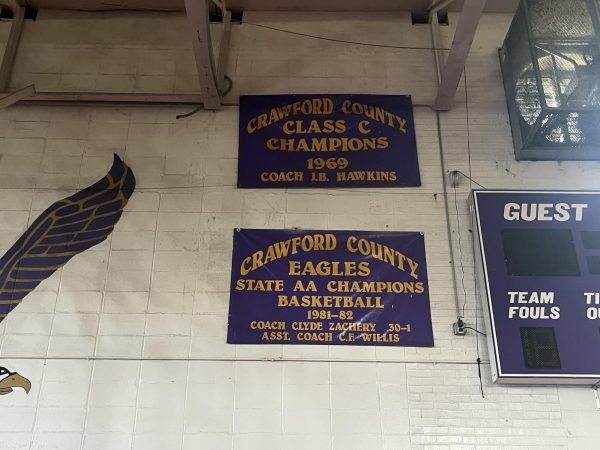
The original gym, built in the 1950s, sits quiet, a banner commemorating the 1969 championship team still on the wall. Its floor is polished but empty. Its locker rooms worn with age, and its trophy cases still filled with mementos of a bygone era.
For decades, though, it was anything but quiet.
“Oh, it was packed and wild and loud,” Chuck Hawkins said, reminiscing on his playing days.
He said the gym was more than just a place to watch basketball. It was a gathering place for the entire community.
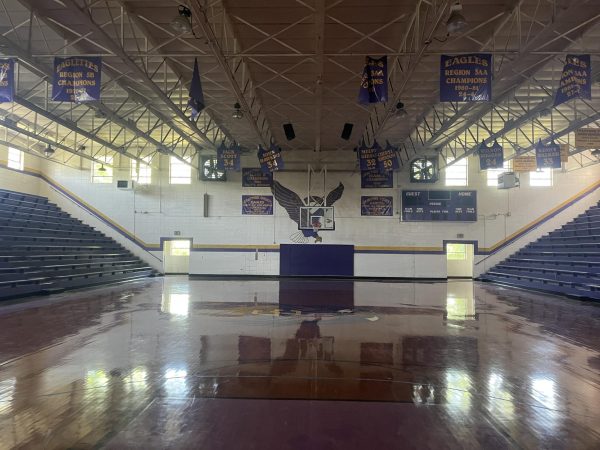
“The whole town would turn out,” Hawkins said. “There wasn’t anything else to do out there. We didn’t have a movie theater or golf course, or anything like that. We had basketball.”
That picture of Roberta as a place where the gym became the center of town life matches the memories of another Crawford County legend, Kenny Walker.
Directly below the banner commemorating the 1969 championship team is another state championship banner, this one from the 1981-82 season.
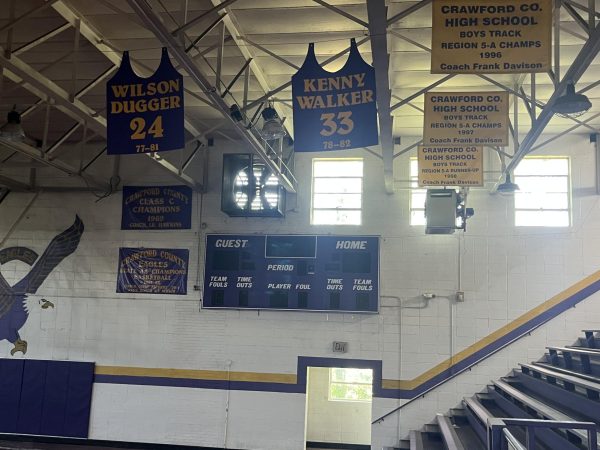
Kenny Walker
Walker was the greatest athlete to ever play at Crawford County, leading the school to back-to-back state titles in 1981 and 1982. He later became a two-time SEC Player of the Year at the University of Kentucky and was selected fifth overall in the 1986 NBA draft by the New York Knicks.
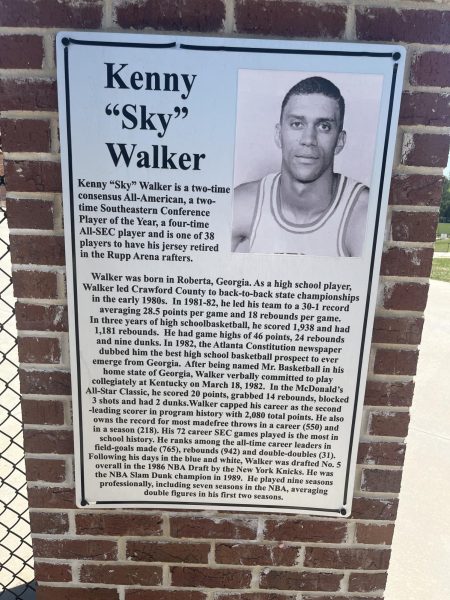
- A sign outside of Crawford County’s new gymnasium, commemorating Walker’s outstanding basketball career. (Harrison Montavon )
“Before I even played for Coach Hawkins, I saw how he coached my older brothers,” Walker said. “He was a fundamental guy. He was a good teacher of the game. He was a disciplinarian.”
For Walker, the connection between Hawkins and Roberta’s love of basketball is direct.
“What Coach Hawkins started, that’s what my generation and people remember growing up. Those are some of the best memories that we had in that little small town.”
Walker said Hawkins’ influence stretched beyond Roberta itself and is a huge factor as to why Middle Georgia remains an important basketball area today.
“There’s no question that Coach Hawkins was the guy that built that legacy,” Walker said.
Walker believes Hawkins was crucial in his development as a player. Hawkins saw his potential early, moved the young forward up from junior varsity as a freshman and gave him early opportunities with the varsity team. Years later, Walker still remembered Hawkins’ practice drills, including using weighted vests to help players build strength and increase vertical jump.
Walker later won the NBA Slam Dunk Contest in 1989 and became known for his high-flying athleticism, something those early drills in Roberta may have helped shape.
Bringing Roberta Together
In an era when schools and communities across Georgia were still navigating the effects of segregation, Walker said Hawkins worked to bring players together and encouraged Black athletes in the community to come out for the team.
“I think basketball was a great way for Coach Hawkins to bring black, white, or whoever together,” Walker said. “We’ll build a good team for our community so everyone can be proud of it. And that’s what he did.”
That kind of community-building is a big reason Hawkins’ legacy has lasted.
Walker’s own story reflects the reach of the culture Hawkins built. Raised in a working family, he said his summers were spent picking peaches and pecans before heading to play basketball later in the day. That work ethic, combined with Hawkins’ teaching, helped prepare him for the path that eventually led him from Roberta to playing basketball at the highest level.
Hawkins’ Commitment and Selflessness
Dr. Chuck Hawkins said his father’s success came from something simple but demanding: detail, repetition, and total investment. Long before youth leagues and travel circuits became common, he started players young, identified talent early and taught fundamentals from the ground up. And he did much more than coach during games.
“He would wash the players’ workout clothes after the game and he would buy them tennis shoes,” Hawkins said.
His father and the family would even clean the gym themselves after games, sometimes returning on Saturday mornings to mop the floor.
Chuck Hawkins said that his work ethic carried into every part of his father’s life.
“He just wanted to do everything the best he could,” he said.
That kind of work and dedication to Crawford County High School and its players is what built the school into champions, even beyond Hawkins’ tenure there.
Hawkins laid the foundation for the program that would break through again in the early 1980s. Before the 1981 season, Hawkins had stepped aside, and his longtime assistant, Clyde Zachary, had taken over. Coach Hawkins knew how talented the roster was, especially with Kenny Walker quickly becoming one of the top prospects in the nation, yet decided to step down.
Hawkins believed that Zachary could better lead Walker to his fullest potential, and felt it was a better fit for the up-and-coming star.
Walker said that decision showed the kind of coach Hawkins was.
“When Coach Hawkins turned the program over to Coach Zachary, there was no rebuilding,” Walker said. “He had everything in place right when he took off for him. Boy, that’s the greatest gift that you can give an incoming coach.”
The school went on to win back-to-back state titles in 1981 and 1982, with Zachary and Walker leading the way. Walker called Hawkins’ decision to step aside “the ultimate sacrifice,” the move of a coach willing to let go, even with one of the best players in the country coming into his prime, because he believed it was right for the program.
Remembering Coach Hawkins
Following Hawkins’ retirement from coaching, he remained heavily involved at Crawford County. He would go on to accept the role of the school’s athletic director in 1980 and would eventually help coach the baseball and track teams years later.
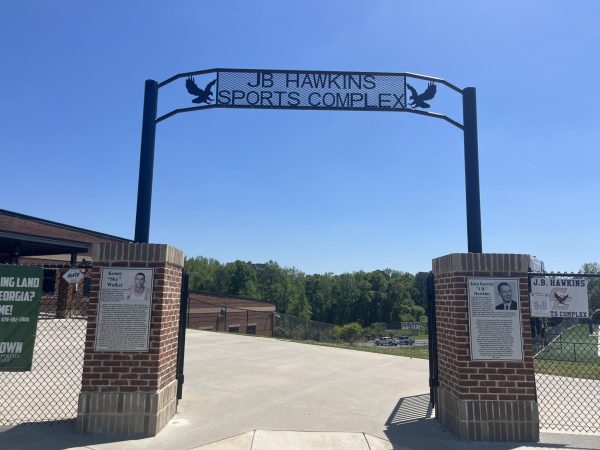
Although Coach Hawkins passed away at the age of 90 in 2011, he remains a visible part of Georgia’s basketball landscape with his name living on through the J.B. Hawkins Christmas Tournament, the J.B. Hawkins sports complex at Crawford County High School, and Hawkins Arena at Mercer, which was renamed in 2012 after a gift from his son, Dr. Chuck Hawkins, and daughter-in-law Kathy.
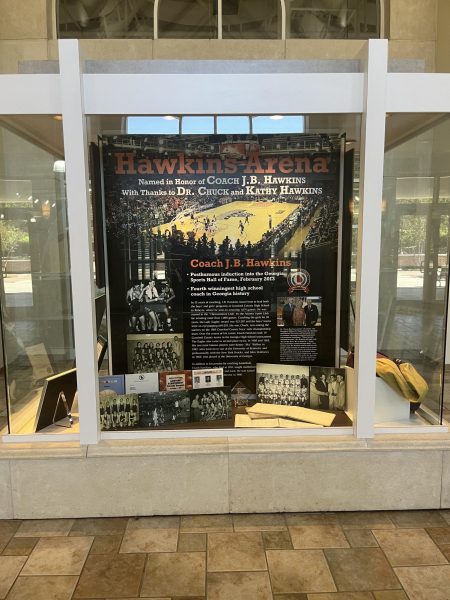
“I just thought it was a good way to honor him,” Chuck Hawkins said. “He was just a teacher and a coach, but I just saw how he interacted with people and how respected he was in our community.”
There is also the J.B. Hawkins Humanitarian Award, created by the Georgia Sports Hall of Fame. The award is given to someone from a small community who made a strong positive impact, reflecting a part of Hawkins’ legacy that went beyond basketball.
Even now, Chuck Hawkins said, his father’s name still comes up regularly in conversations around Macon and beyond. Right up until his retirement from medicine, he said, patients and old friends would still talk to him about J.B. Hawkins and the teams he coached.
“He definitely touched a lot of lives in Georgia,” Chuck Hawkins said.
When Macon hosts the state championships each March, it is not just serving as a neutral site. It also represents a wider Middle Georgia basketball culture that was built over decades by coaches, players, and communities who treated high school basketball as something bigger than a game.
And in Roberta, that legacy is still visible even as the setting changes. The old gym no longer hosts the school’s daily life, or the roaring crowds, but Chuck Hawkins said there is now an effort to preserve it, with former Crawford County girls star Cheryl Johnson helping lead the push. The hope is not just to save a building, but to protect a place that once served as the focal point of the town.
Puckett said the school’s new campus is still adding graphics, displays and reminders of Hawkins’ career, making sure the next generation knows who he was.
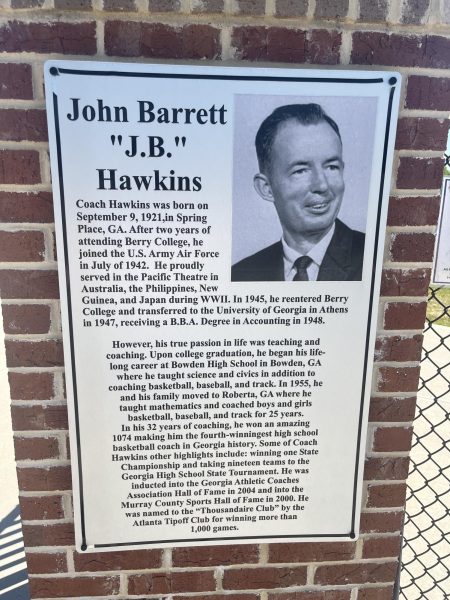
“His name is still very well known,” Puckett said. “We still incorporate a lot of what he taught.”
Hawkins was not just a coach who won games. He was a teacher, a disciplinarian, a mentor, and, most of all, a community builder. In a small town like Roberta, that fell in love with basketball, that may be why his name still means so much.