


The first NCAA Men’s Basketball Championship was in 1939, where the University Of Oregon Ducks claimed victory. At the time, there was no women’s basketball championship.
While the National Collegiate Athletic Association was founded in 1906 to reform and regulate college sports, these reforms did not initially include women’s athletics.
Women’s basketball would not be added as an NCAA-recognized sport until the 1981-1982 academic year, more than 70 years after the association’s founding. It was not until President Richard Nixon signed the Education Amendments Act (EAA) in 1972, which includeD the Title IX, that discrimination based on sex/gender was formally prohibited at institutions receiving federal funding which applies to nearly every NCAA school.
At the time, women’s sports, including basketball, were governed by the Intercollegiate Athletics for Women (AIAW) an organization led by women. Although the NCAA was initially resistant to integrating women’s athletics, the passage of Title IX forced the NCAA to comply. In 1981, the NCAA absorbed the AIAW’s authority and began hosting women’s championships. While this shift brought greater national attention to women’s sports, it did not automatically deliver equal treatment or investment.
Today, women’s basketball programs, particularly at the Division 1 level, often receive fewer resources and significantly smaller budgets than their male peers. Yet in recent years, the women’s game has seen historic growth in popularity with sold out games, record breaking viewership of 13 million on average, and multi-million dollar NIL (Name, Image, Likeness) deals reshaping the landscape.
This rapid growth raises a crucial question: Are NCAA budgets keeping up with the women’s game’s rising success?
To answer this question, I analyzed data from four major college conferences- the ACC, Big Ten, Big 12, and SEC covering the years 2018-2022. These conferences were selected because they house some of the most competitive, nationally ranked programs that command significant media attention and revenue. Data from the 2023-2024 season was not yet available at the time of this project.
What the Data Shows: Funding Gaps Persist
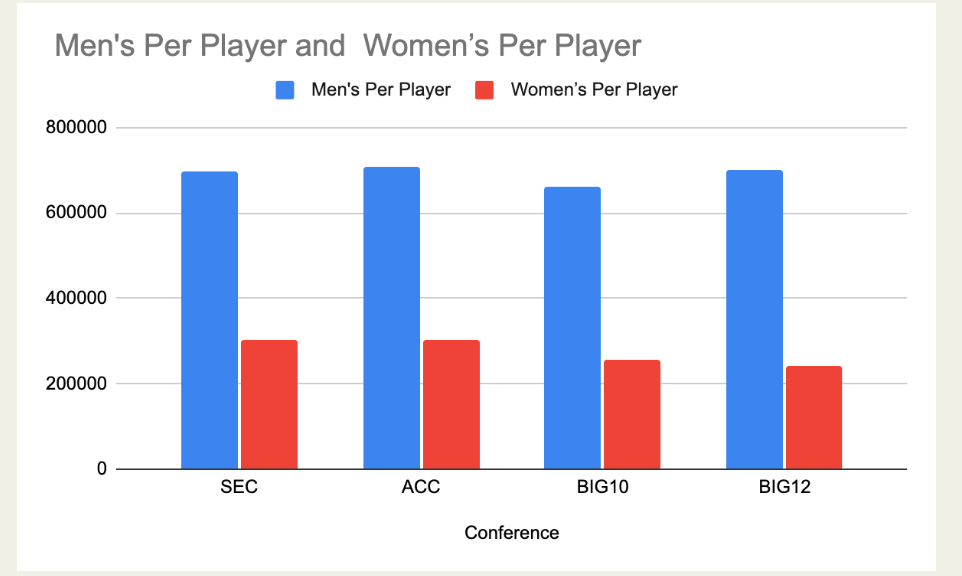
Upon analyzing data from the U.S. Department Of Education’s Equity in Athletics Data Analysis (EADA) a clear trend emerged: men’s basketball programs consistently receive more financial support than women’s programs.
Across all four conferences , men’s teams were allocated between $10.5-12.4 million annually, while women’s teams received only around $5.3-6.6 million on average. The SEC and ACC spent the most on both men’s and women’s programs overall, but the gap between men’s and women’s funding remained wide among the highest spending conferences.
The disparity becomes even more clear when accounting for roster size. Men’s players received more than double the financial support per athlete compared to women’s players. In the SEC, the average men’s per player expense was approximately $695,836, compared to $303,938 for women. In the Big 12, the gap widened with men receiving about $701,063, per player, while women received $240,415.
The funding gap is not simply a factor of larger men’s roster or different operational costs- it could reflect a systemic undervaluing of women’s athletics, even as the women’s game continues to grow in performance, popularity, and cultural relevance.
Some schools are leading the charge toward equity. Programs like South Carolina, Baylor, Notre Dame and Penn State showed either near equitable funding or, in the case of South Carolina, years where the women’s teams received more financial support than the men’s. These outliers suggest that funding equity is not only possible- it’s happening in schools that actively choose to prioritize and invest in women’s basketball.
But these programs remain the exception. On the other end of the spectrum, schools like Kentucky, Michigan State, Texas, and Duke demonstrated some of the most significant funding gaps with men’s basketball teams receiving anywhere from $11 million to over $20 million more annually than their women’s teams. This financial imbalance exists despite the success and rising marketability of women’s programs at these same institutions.
While revenue is often used to justify the funding gap, even those numbers are shifting. From 2018-2022 average annual revenue for women’s programs rose from $2.45 million to $3.5 million, a gain of more $1 million. In contrast, men’s programs grew from $15.9 million to $17.6 million in the same period. Although the women’s numbers are still lower, their rate of growth is climbing, and the gap is not insurmountable as it once appeared. Additionally a reason for women’s lower revenue can be connected to women’s programs receiving lower expenses putting them a disadvantage from the beginning.
These revenue gains are happening despite decades of underinvestment. Yet, the progress seen today must be understood in the context of the barriers that women’s basketball programs have historically faced — some of which only came to national attention recently.
It is important to note that under Title IX and NCAA regulations, athletic departments are not required to spend identical dollar amounts on men’s and women’s sports. Instead, equity — not necessarily equality — is the standard.
Schools must provide equitable treatment, benefits, services, and access to resources for men’s and women’s programs.
This includes areas such as coaching quality, facilities, travel accommodations, medical services, publicity, and scholarship opportunities.
Major funding gaps are not inherently a violation of Title IX; however, they can signal broader systemic inequities if they result in significantly lower access or support for women’s teams.
In the context of basketball, the sharp disparities in per-player funding, equipment, facilities, and staffing raise critical questions about whether schools are truly meeting the spirit — and sometimes the letter — of Title IX compliance.
Setbacks Along the Way: The 2021 & 2024 March Madness Controversy
During the 2021 NCAA Women’s Basketball Tournament, inequalities between the men’s and women’s experiences were exposed. Sedona Prince, a former Oregon University women’s basketball player, showed the difference between the facilities provided. Women’s teams were given only a single dumbbell rack while the men’s teams received access to a full professional-grade gym.
Making matters worse, years later in the 2024 Women’s March Madness tournament it was revealed that the court had an uneven three-point line — a basic detail in court setup that had been overlooked. These embarrassments, reported widely across the sports world. The forced NCAA to conduct an external gender equity review and publicly acknowledge the persistent disparities in how men’s and women’s tournaments were managed.
These incidents served as a wake-up call, not just to the NCAA but to the broader public and media. They made visible the underlying issues of inequality that athletes, coaches, and advocates had been calling out for years.
A New Milestone: Financial Recognition for Women’s Team
In response to the outcry and ongoing criticism, changes are slowly being made. In 2025, for the first time in NCAA history, women’s basketball teams participating in March Madness were set to performance units — financial payouts based on how far they advance in the tournament. This model has existed for men’s basketball teams since 1991.
According to reporting from The San Francisco Chronicle (Killion, 2024) and Just Women’s Sports (2024), the NCAA has allocated $15 million toward these performance units for the women’s tournament. This move represents a significant acknowledgment of women’s contributions to the NCAA’s growing revenues, and is a critical step toward closing the financial gap that has persisted for decades.
Thriving Despite the Gap: Record-Breaking Viewership and NIL Success
Women’s basketball isn’t just catching up — it’s leading.
The 2024 NCAA Women’s Basketball Championship between Iowa and South Carolina drew 18.9 million viewers and peaked at 24.1 million viewers, according to ESPN Press Room. This figure surpassed the men’s championship viewership by 28% and became the most-watched basketball game — college or professional — since 2019. Tournament-wide viewership for women’s basketball also rose 121% year over year, a staggering increase that underscores the sport’s growing popularity and marketability.
At the same time, individual players are reaping the benefits of their expanding platform. In a 2023-2024 report from SponsorsUnited NIL Marketing Partnerships found that NIL distribution among the top 100 players gave 52% of women partnership in comparion to men getting just 48% of deals.
As Mercer University women’s basketball player Aspen Johnson put it, “People should care about women’s sports because you never know when you’re going to be raising a woman, so it’s important.” Johnson’s words reflect why the rising success of women’s basketball matters beyond numbers — it’s about representation, visibility, and creating a future where women’s sports are valued equally regardless of gender.
Conclusion: Outgrowing Their Budgets
The numbers tell a clear story: Women’s college basketball is thriving — despite budgets that have not kept pace with its success. Johnson says the attention the women game is receiving is amaing and will definitely grow the game.
Even with lower investment, women’s programs are delivering sold-out arenas, historic television ratings, and millions of dollars in brand endorsements. The talent, the audience, and the financial potential are all there. What remains lagging is the willingness of institutions and the NCAA to match that success with equitable financial support.
Women’s teams have long outgrown the excuses that once justified their underfunding.
Now, they’re outgrowing their budgets too — and it’s time for the funding to finally catch up.