
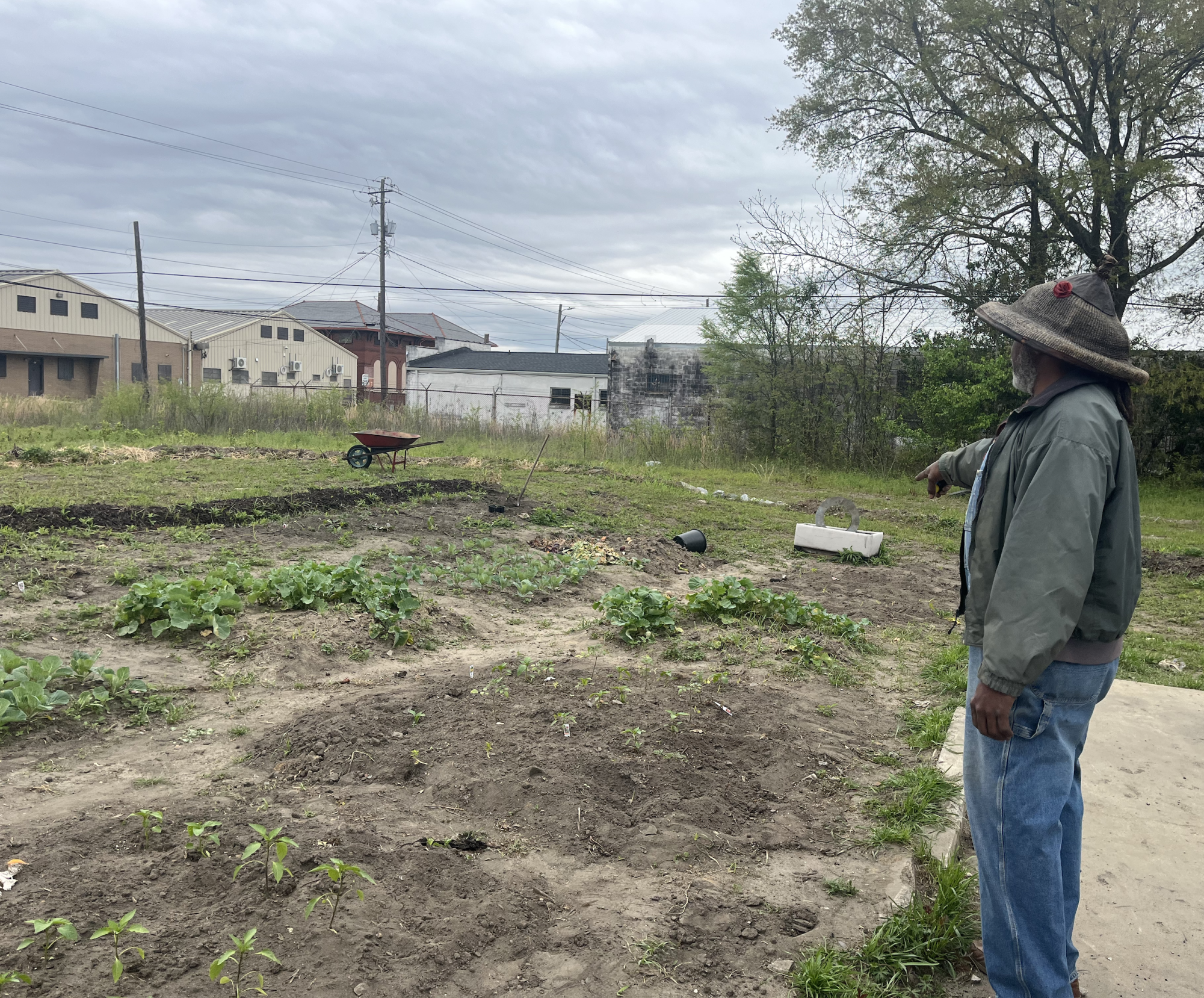
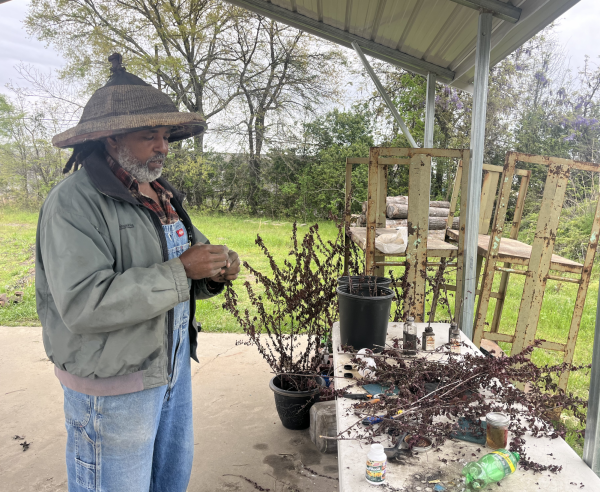
Most days you can find Loy Young out at the corner of Hazel Street and Martin Luther King Boulevard where he is cultivating an expanding area of garden plots and selling fresh produce out of a trailer.
The lot is one of Young’s three “urban farms” where he is growing a seasonal mix of vegetables and planting fruit trees. He’s been in the produce business for years, harkening back to his childhood in Montezuma where he sold purple hull peas.
“I never even knew the significance of food deserts or food insecurity,” Young said. “I was just basically selling produce to try and put some food on the table.”
Young says while his latest ventures started as a way to support himself, he later learned he was providing fresh food in an area with limited options.
“I had set up on Pio Nono and they had closed that Kroger … and it became evident that there wasn’t a grocery store in sight, and I was the only person that had at least something similar to a grocery store,” Young said. “It was like, ‘Do you know how far we would have to go to get a tomato if it wasn’t for you?’ That’s what people used to say.”
In the past decade, Macon’s urban core has seen growth in population, retail and restaurants, but that same time period saw a decline in access to full-service grocers.
The 84,000-square-foot Kroger on Pio Nono was on the border of the core and closed in 2018, and two efforts to bring a smaller grocer to downtown Macon failed after each store was open for a little more than a year.
For residents in the area, accessing a full-size grocer means driving outside the area, navigating the bus system or using a delivery service.
“We have pretty significant portions of the city where somebody has to go a good way to get to a full grocery store,” said Margie Alsbrook, a Mercer University law professor who specializes in food policy.
A U.S. Department of Agriculture map lists many areas of Macon as both “low income” and “low access,” which are terms the USDA began using in 2013 to replace the word “food desert.”
“There is a significant correlation between geography and food access and it’s not quite in the way you would think,” Alsbrook said. “Somebody doesn’t have to be isolated in the middle of nowhere to experience food access issues. The food deserts can be in the middle of a fully populated area.”
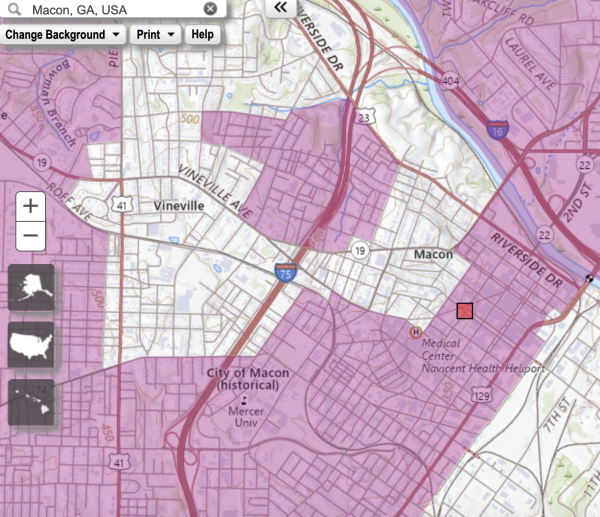
More than half of Macon’s urban core is also considered “low vehicle access,” meaning more than 100 households in each Census tract have no access to a vehicle and live more than a half mile away from the nearest supermarket.
“Food access is really, ‘Is there food in the geographical area that is accessible?’ Food insecurity is more related to whether or not someone can afford to purchase that food or cook that food or prepare that food,” Alsbrook said. “Because you can have a ton of food around you and just not be able to purchase it. On the other hand, you can have a ton of resources and not have access.”
Why Don’t We Have a Downtown Grocery Store?
Downtown Macon has been on the path to revitalization since the late 1990s and this accelerated in 2015 with the first version of the Macon Action Plan, which used direct community input to build an improvement plan for downtown and the surrounding neighborhoods.
There have since been two more versions of MAP — in 2019 and 2024 — and the clamor for a downtown grocer comes up frequently.
“Every iteration of MAP, that has been a top comment,” said Alex Morrison, who is executive director of the Macon-Bibb Urban Development Authority, which has managed the MAP process. “It’s probably the second-most question I get when I speak anywhere.”
There are a number of challenges involved in attracting a full-size grocer to a specific area, and the reality of where grocers locate and the economics of running a store is complicated.
“It is really expensive to provide food access,” Morrison said. “Grocery stores are very expensive and run on a volume game, which is why you see grocery stores getting bigger and bigger and fewer and far between.”
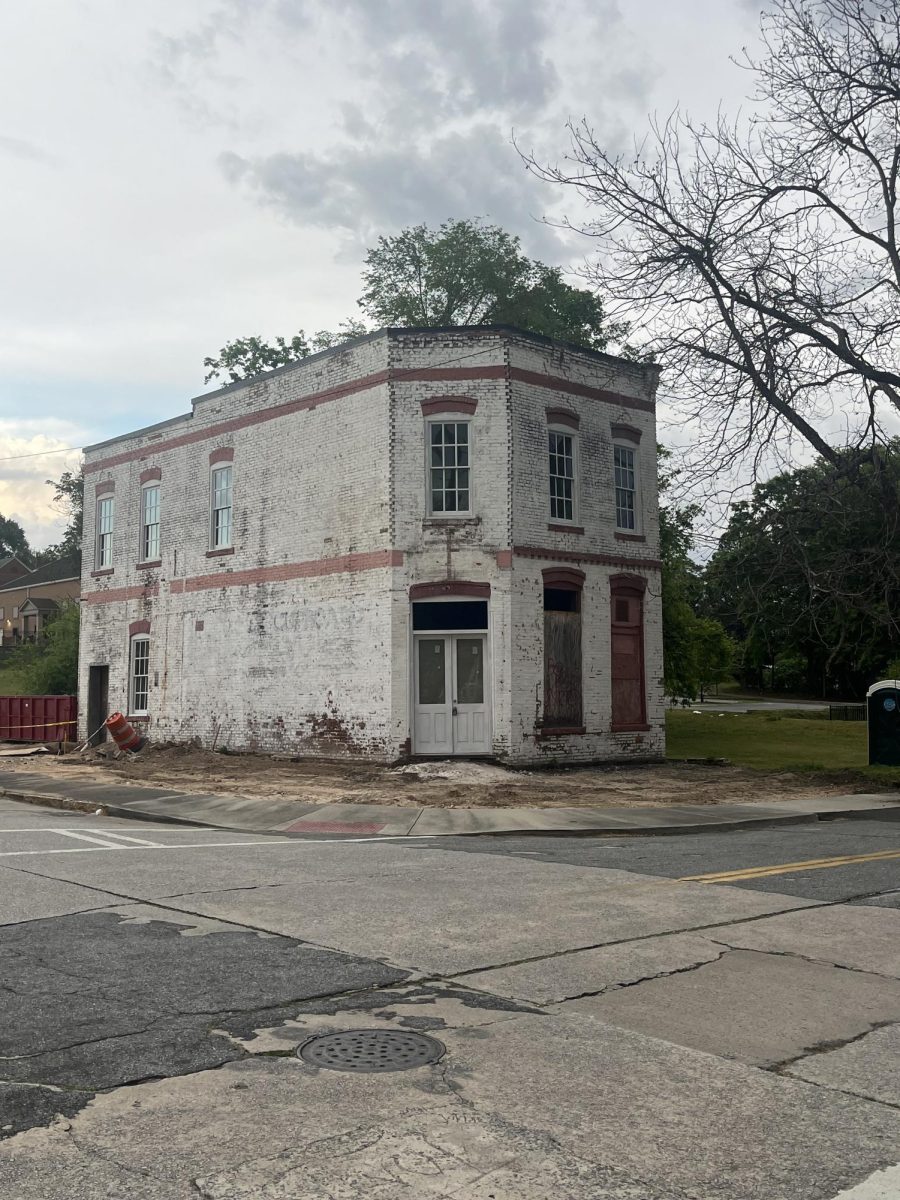
Nearly a decade ago, Laura and Steve Bell first pitched the idea for a downtown grocery store as part of a contest. The idea caught some momentum and investors, and they eventually landed on a Poplar Street location by the Dannenburg Lofts. Ocmulgee Traders opened in June 2014 and included a cafe with sandwiches and snacks. They later added beer growlers to broaden the options for sales.
Laura Bell said they quickly hit financial challenges with supply costs and shrinkage.
“That’s when the food goes bad,” Bell said. “There’s no half-price sale, there’s no 90% off. It’s trash. It’s all gone.”
Bell said they had a great supplier but the vendor required a minimum order of $10,000, and it wasn’t financially feasible to make an order when they just needed a few items.
“When you’re out of toothpaste, you don’t need $10,000 of stuff and you don’t want $10,000 more in debt to just get toothpaste,” Bell said. “So, you’re running to Sam’s and Kroger and finding deals so I can restock stuff like that.”
Bell said the Dannenburg Lofts were about 90% occupied when they ran Ocmulgee Traders.
“So we knew that was a big market for us,” Bell said. “I think we got them some times but I think most of our business, when it was popular, was just people who work downtown coming for lunch and buying some groceries, but we could not really make the grocery sustainable.”
While the population of downtown swells as high as 30,000 during working hours, Morrison said only about 1,200 live full time in the square mile of downtown. He says that area would need another 5,000-10,000 residents to interest a larger retailer.
“When you don’t have that population base there, it means you have to sell the few items you can sell at a high rate,” Morrison said. “It created a market condition where it was just not profitable to open smaller grocers in most places because there wasn’t enough density in areas of people who had the means to pay to support a grocery.”
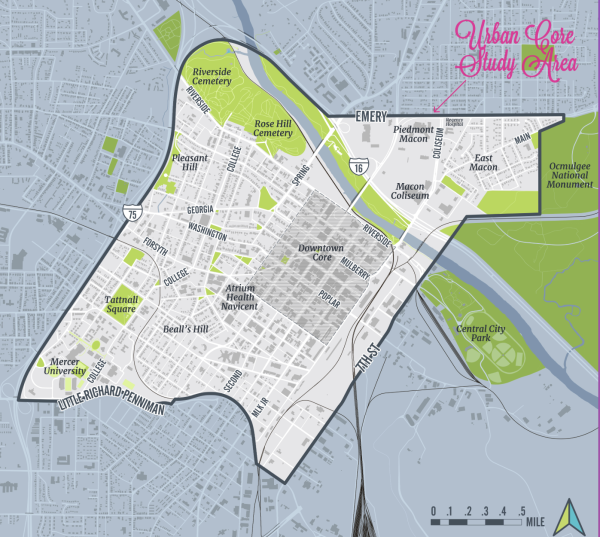
As downtown projects like more lofts, a new arena and a new Mercer Medical School are built, Morrison said there are some sites downtown that could work for a larger retailer but even then, a drive-by analysis from those retailers might not reflect a need for a grocer there.
“If someone who is a Trader Joe’s or a Whole Foods or Kroger or Publix or Walmart neighborhood grocery, if they were, say, ‘I’m really interested in Macon, in that market,’ and if they pull a snapshot of downtown Macon, the thing that they’re going to see is that there is a full service Kroger less than a mile away,” Morrison said. “And it makes it look like downtown Macon is massively oversupplied for grocery.”
In the historic downtown specifically, site location can be another obstacle.
“Even up to the ‘90s, (retailers) were perfectly happy to take over an older space,” Alsbrook said. “But now they want to build their own stuff from scratch. They have their own real estate department, they have their own architect, they have their own branding that they want to see. They have modules and shelving and everything that they have created and they want it to all work.”
Bell said opening Ocmulgee Traders in a historic building presented unique challenges. The floors weren’t level in some places, the building had high heating and cooling costs, and their refrigeration needs were a drain on the overall power to the space.
Before the Bells opened their store on Poplar Street, they visited smaller grocery stores in Europe that were succeeding in urban areas.
“And a big difference is that they are not car dependent,” Bell said. “So people would shop one or two days at a time, so you can keep everything fresher. You don’t have to get a ton of peaches when you’re only going to sell this many every couple of days. So you just get this many and then you get this many more two days later.”
Alsbrook also said the region’s strong “car culture” makes smaller, urban stores a harder sell than in communities where public transportation and urban density are more the norm.
“Where you really see those (markets) are in the walkable areas where not everyone has a car,” Alsbrook said. “And some of that’s just the price point because (shoppers) will trade off paying 25 cents, 50 cents, $1 more an item because they are not paying to move a car.”
Bell noted that car culture also means we tend to make larger, less frequent grocery trips.
“We tend to shop — I mean, I always do with kids — a week at a time,” Bell said.
The rise of Instacart and other food delivery options also changes the dynamics of where people can shop and at what price point.
“So people can, even without the drive, they’re going to be able to purchase cheaper items than what you could get at a specialty grocery,” Morrison said.
What’s Next For Macon’s Urban Core?
Macon’s Urban Development Authority is trying to spark better access in some of the city’s food deserts, but this has been a challenge. In November 2024, the Macon-Bibb County Commission gave $3.2 million in American Rescue Plan Act funds to “incentivize brick-and-mortar grocery stores to locate within food desert areas.”
A former Piggly Wiggly store on Napier Avenue was identified as a place to try and bring in a new retailer, but issues with the building and site drove the costs too high and the idea was abandoned. Morrison also said the store would be considered too small by today’s chain grocer standards but is too big for what smaller neighborhood markets look for.
“So what we have attempted is to be able to use money as a deal sweetener for somebody to go into a market that they otherwise wouldn’t go into,” Morrison said. “But there’s just not a lot of folks who are in that game.”
He said commercial grocers look for places that have “good access, good parking, good overall economics” and this covers things like population, educational attainment and median income.
“But often what I have found is there’s incentive steep enough that can overcome those market conditions,” Morrison said. “So it’s not a question of can local governments support grocers in areas that are food deserts, it’s how can we change the market conditions within food deserts so they can support a grocer?”
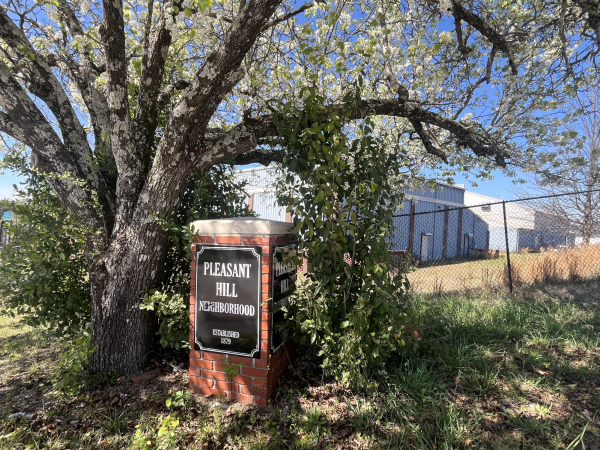
UDA is now looking to attract a food retailer to the Pleasant Hill neighborhood at the site of the former Macon Charter Academy and adjacent to a new multi-family housing development in the works. Construction on the housing started last month with a groundbreaking.
“Our goal is to build out that space and have the neighborhood guide us on what the right solution is,” Morrison said.
Andrea Cooke is also trying to address better food access in the Pleasant Hill neighborhood. She founded the Napier Heights Food Co-op in 2021 after seeing how the pandemic changed access — specifically for school-aged children.
The idea had been to start a co-op, which are typically owned by community members who pay a membership fee, volunteer labor or do both to shop there.
“We could not quite figure out how to create a traditional co-op model fast enough,” said Cooke, who also manages the Booker T. Washington Center and is development director for Macon Mental Health Matters. “So we started a market instead with the idea of eventually having a shared family co-op.”
The Napier Heights Co-op opened in 2022 as a weekly market of some food and craft items in Tattnall Square Park. The market moved to the Booker T. Washington Center last year before closing completely in September 2025.
“We wanted people to have a good variety of items and then I think in some ways people were potentially fearful of coming to an impoverished neighborhood to sell,” she said.
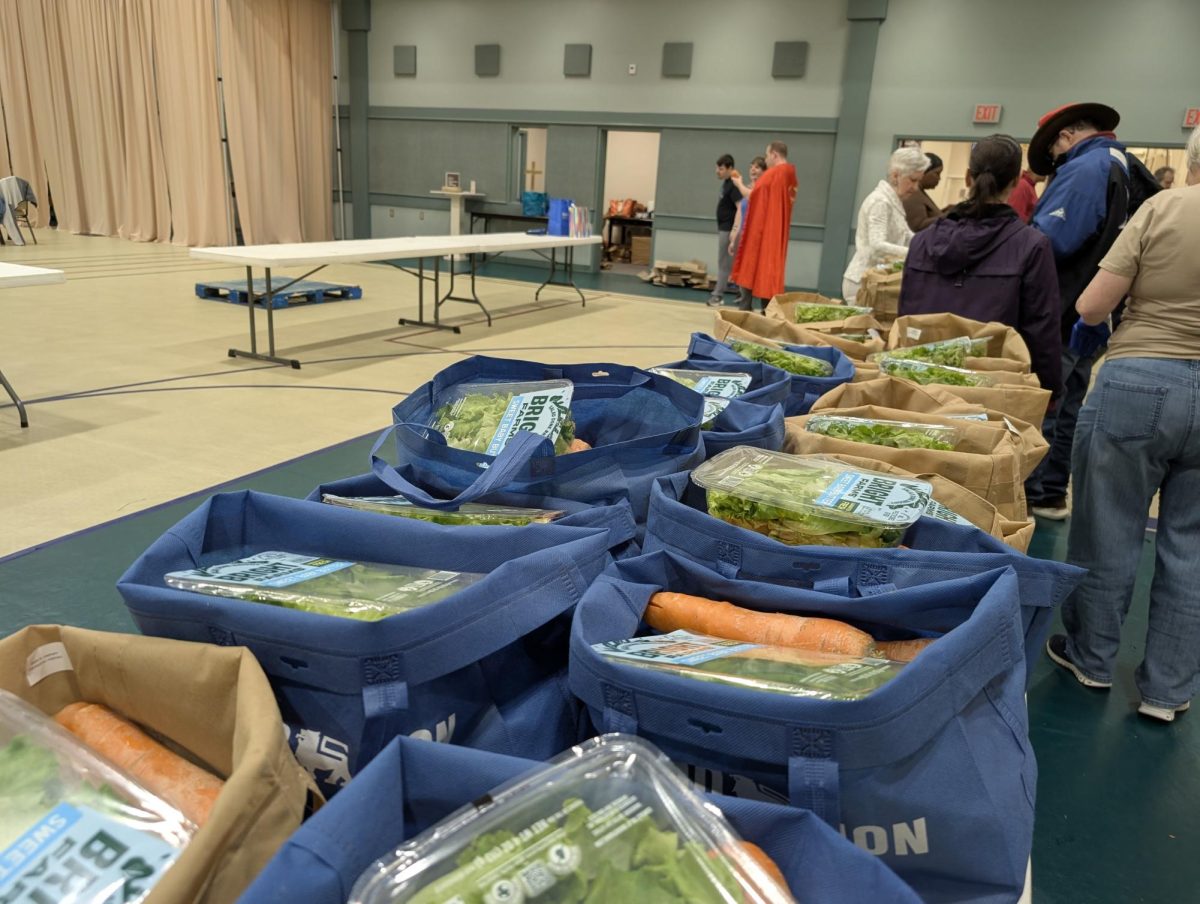
Cooke is planning to relaunch this September with a true co-op model that would be open to 50 families who pay $25 a month. The funds would be used to make group food purchases and five member families would pack and distribute the bags each month.
She said she welcomes efforts to bring a grocer to the neighborhood and it would be an opportunity for the co-op to partner.
While there are some examples of successful markets and co-ops in urban areas, they are often the exception and not the norm.
“I cannot think of a place that has had a giant shift across a huge swath of a city,” said Alsbrook, who has been involved with food law and policy for the last 20 years. “That doesn’t mean it’s not out there.”
Bell said the successful markets or co-ops they encountered in their research were often driven by a specific person.
“The only small stores that we researched in this country were like in Atlanta, and it was a neighborhood effort, and somebody said, ‘I’ll do it,’ and then everybody supported it,” she said. “But I don’t think they lasted.”
Morrison noted that food access isn’t a problem that exists on its own.
“The economics of it are sprawl. They are neighborhood disinvestment. They are lack of access to high-paying jobs,” he said. “So if we want to address the food access issue, we really have to address those other issues first.”
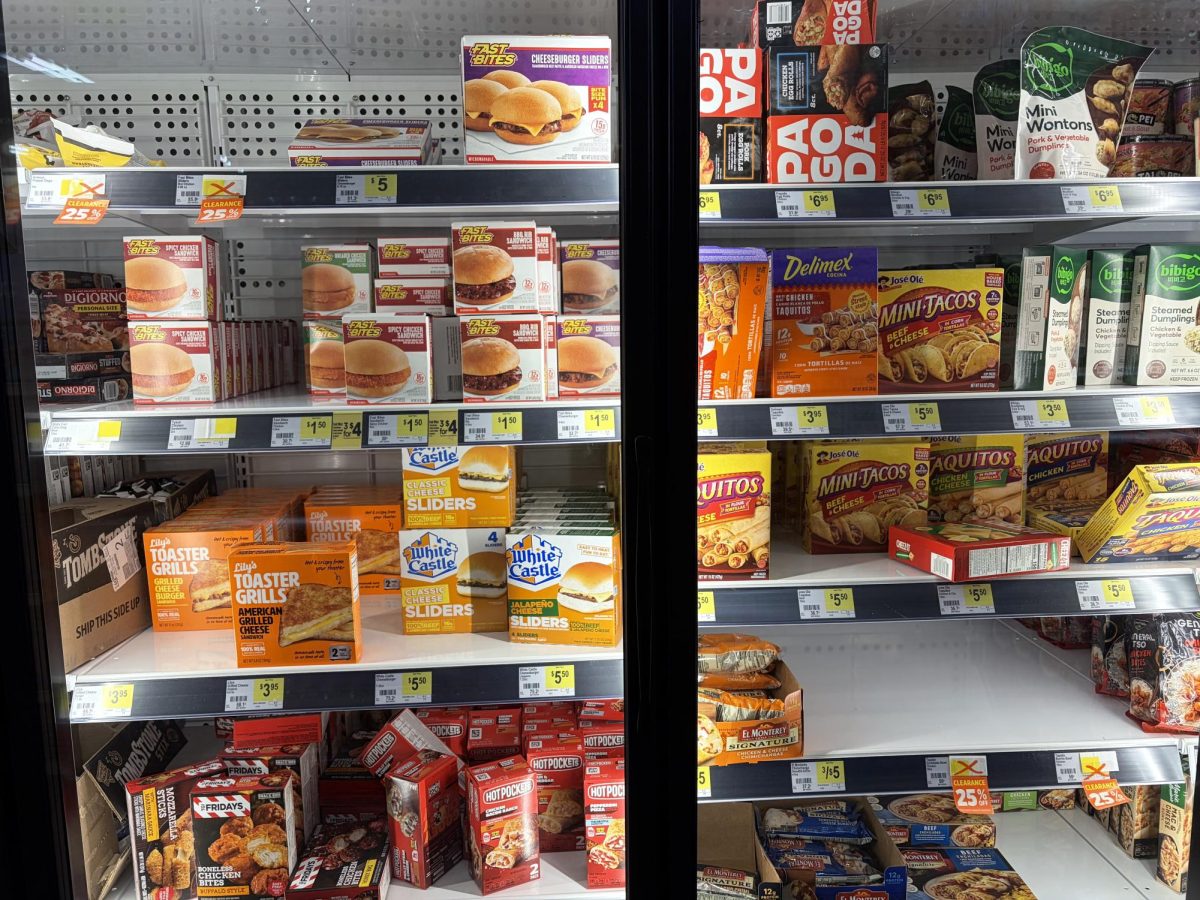
In the urban core today, residents can buy fresh produce at Loy’s Market Wednesdays through Sundays or visit the Poplar Street Market on Wednesday afternoons. The Dollar General on Martin Luther King Boulevard sells dairy, freezer items, bread and shelf-stable packaged items. But, finding packaged food and fresh items in one place still means leaving downtown.
“It’s not to say that the right model couldn’t work with all of the development that we have coming online … like you’re going to see the largest increase in housing in a very long time. The dynamics could change and a grocery could work … The primary reason that it hasn’t happened is that there’s just not enough rooftops that are that would support it, or who would choose to support paying higher prices, versus going to Kroger,” Morrison said.